
How An Archduke's Assassination Sparked The Great War
Ferenc Ferdinánd és Chotek Zsófia szarajevói látogatása by Ismeretlen fényképész - Hungarian National Museum, Hungary - CC BY-NC-SA.
For nearly half a century, the western world had been tranquil and had seemed safe… People went on their summer holidays; shops reassured their customers with the announcement “business as usual.”
H.G. Wells
On a sunny Sunday morning, June 1914, in the city of Sarajevo, two lives were taken — and the world changed forever.
Archduke Franz Ferdinand, heir to the Austro-Hungarian throne, and his beloved wife, Duchess Sophie, had chosen an inauspicious date for a state visit to the recently annexed province of Bosnia. Their presence was meant to project imperial strength, but it collided with a rising tide of Slavic nationalism, stirring up a crisis that would explode into the Great War just weeks later.
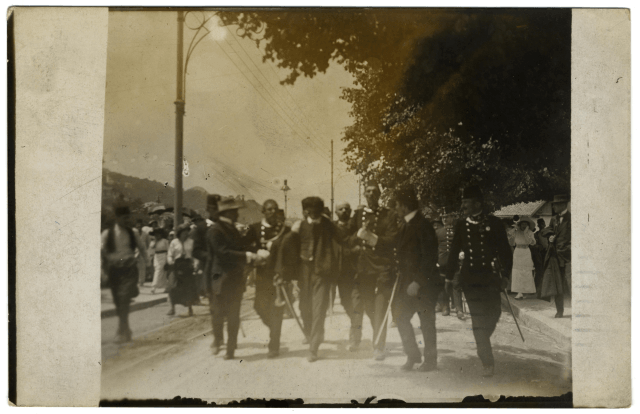
Gavrilo Princip elfogása by ismeretlen fényképész - Hungarian National Museum, Hungary - CC BY-NC-SA.
A parade, a plot, and a misstep
On June 28, 1914, Archduke Franz Ferdinand and his wife Sophie arrived in Sarajevo. Franz Ferdinand was there to observe army maneuvers, while the Duchess spent time taking in the local sights. The couple’s visit had been publicized as early as February, and among the crowds lining the motorcade route were seven conspirators, members of the Black Hand, a secret Serbian nationalist group.
They were armed with pistols, homemade bombs, and cyanide tablets, waiting for the right moment to strike. One of them, Nedeljko Čabrinović, threw a bomb at the Archdukes’ car. It bounced off the folded convertible roof and detonated under the vehicle following behind, injuring two officers.
Franz Ferdinand insisted on continuing his official duties, exhibiting that very calm resolve that endeared him to the public, but sealed his fate. The Archducal party made its way to the town hall, where the Lord Mayor stumbled his way through a welcoming speech.
It was then decided that the party would visit the military hospital to see the wounded. Having left the hospital, the Archduke’s driver was going the wrong way. As the driver braked the car Gavrilo Princip, waiting for his opportunity, stepped onto the running board and shot the Archduke and the Duchess.
"Sophie, Sophie, don’t die! Stay alive for our children!" – Last words of Franz Ferdinand, as reported by witnesses
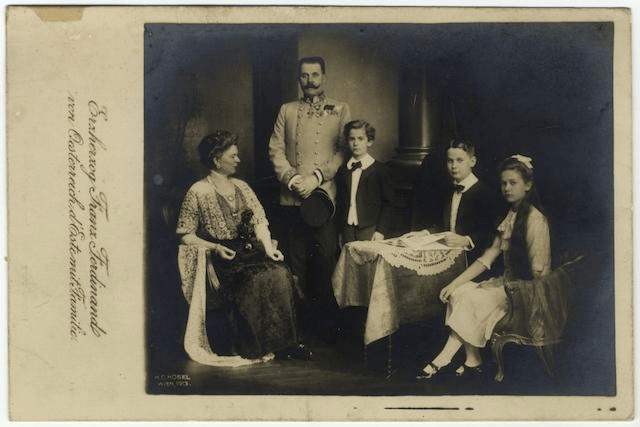
Ferenc Ferdinánd feleségével és gyermekeivel by ismeretlen fényképező - 1913 - Hungarian National Museum, Hungary - CC BY-NC-SA.
Shockwaves through Europe
Assassination was the prevalent form of political protest at the end of the 19th century and the beginning of the 20th century. An emperor, four kings, three American presidents, the Empress of Austria, two monarchical heirs, and various other political figures were bombed, shot, or stabbed to death by 1911.
The murders of Archduke Franz Ferdinand and the Duchess Sophie though tragic, were hardly unique on a continent plagued by political violence. So why did this assassination trigger the deadliest war in history?
The answer lies in the interlocking alliances and rival nationalisms that had been simmering for decades, transforming a regional crisis into a global catastrophe. The assassination of Archduke Franz Ferdinand provided the spark, leading Austria-Hungary to blame Serbia and issue a harsh ultimatum designed to be rejected.
Serbia, confident in the backing of its Slavic ally Russia, indeed refused the most stringent demands. This defiance prompted Austria-Hungary to declare war on Serbia, setting off a chain reaction. Russia, committed to defending Serbia and asserting its influence in the Balkans, began to mobilize its vast army.
Germany perceived this move, Austria-Hungary's powerful ally, as a direct threat. Germany swiftly declared war on Russia, and, anticipating a two-front war, enacted the Schlieffen Plan, invading neutral Belgium to attack France.
This violation of Belgian neutrality, combined with existing Anglo-French understandings, drew France and Britain into the conflict. Within weeks, much of Europe was engulfed in a war that would leave over 16 million combatants and civilians dead and redraw the map of the continent.
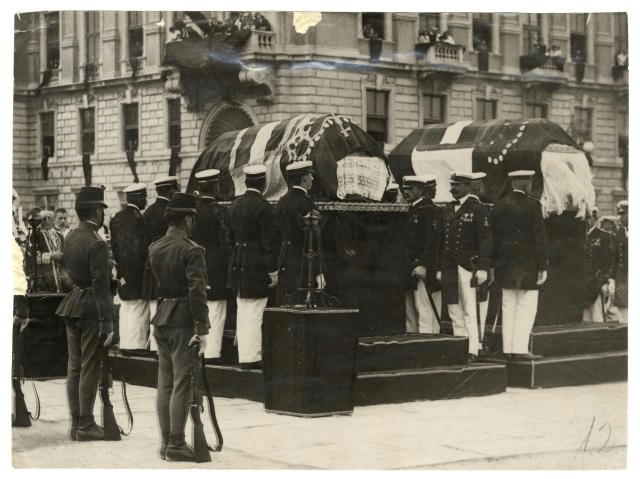
Ferenc Ferdinánd és felesége Chotek Zsófia koporsója by Ismeretlen fényképész - 1914 - Hungarian National Museum, Hungary - CC BY-NC-SA.
A World at War
In hindsight, it seems almost unbelievable that two gunshots could unleash such devastation on the world. But the assassination was merely the spark. The powder keg had been ready for years, made volatile by imperial competition, secret treaties, alliances, nationalism, military buildups, and wounded or overweening pride.
Even before the funeral in Vienna, on July 3, had taken place, the discussions had begun about what Austria-Hungary should do in the face of this provocation by Serbia. At a meeting between Emperor Franz Joseph and his Foreign Minister, Leopold von Berchtold, it was decided that Austria-Hungary must assert itself as a great power again.
The deaths of Franz Ferdinand and Sophie were mourned across Europe. Yet few could have imagined that this moment of mourning would become the opening act of a global conflict that would redraw borders, destroy empires, and change history forever.
Events that led to the Great War
1879: Dual Alliance formed between Germany and Austria-Hungary. Mutual defense pact against Russia.
1882: Triple Alliance formed (Germany, Austria-Hungary, Italy).
1894: The Franco-Russian Alliance was formed to counterbalance the Triple Alliance.
1904: Entente Cordiale signed between Britain and France.
1907: Triple Entente formed (Britain, France, Russia). Europe is split into two major alliance blocs.
1908: Austria-Hungary annexes Bosnia-Herzegovina, angering Serbia and Russia.
June 28, 1914: Assassination of Archduke Franz Ferdinand and Duchess Sophie in Sarajevo by Gavrilo Princip.
July 23, 1914: Austria-Hungary issues ultimatum to Serbia.
July 25, 1914: Serbia responds, partially accepting demands. Austria-Hungary deems it unsatisfactory.
July 28, 1914: Austria-Hungary declares war on Serbia.
July 30, 1914: Russia begins full mobilization to support Serbia.
August 1, 1914: Germany declares war on Russia.
August 3, 1914: Germany declares war on France.
August 4, 1914: Germany invades Belgium. Britain declares war on Germany.
August 6, 1914: Austria-Hungary declares war on Russia. World War I has begun.
Did You Know?
- Franz Ferdinand's car is preserved in the Heeresgeschichtliches Museum in Vienna.
- June 28 was St. Vitus Day, the anniversary of the 1389 Battle of Kosovo, significant in Serbian history.
Sources and References
World History Encyclopedia – https://www.worldhistory.org/article/1560/the-assassination-of-archduke-franz-ferdinand-28-j/
Library of Congress – https://www.loc.gov/collections/world-war-i-daily-mirror-articles/
Smithsonian Magazine – https://www.smithsonianmag.com/history/true-story-killer-who-started-world-war-i-180951072/
Internet Archive – https://archive.org/details/roadtowar191400fayrich
I sincerely hope you enjoyed this post. I have long wanted to share my fascination for history with others. So, watch for future posts.
~~ Joyce

We Share Well-Being Articles, Courses, & More!
Quick links
©2025 - All Rights Reserved
Created with © systeme.io